Get a free roof inspection. Leave your number and we will call you back.
Got it.
Call (818) 934-0075.
How long a roof lasts depends on the material, the installation and the upkeep. In the Valley, heat is one of the biggest factors.
Why the Valley is hard on roofs
The San Fernando Valley and nearby inland areas get long, hot, dry summers. Roofing materials expand in the day and contract at night, and sun breaks down asphalt shingles and sealants over time. A roof in a hotter spot with little shade usually ages faster than the same roof in a cooler, shaded one.
What affects how long yours lasts
- The material: tile, asphalt shingle, flat roofing and metal all age differently.
- The installation: flashing, underlayment and ventilation done well add years. Done badly, they cost years.
- Sun exposure and shade: a south or west facing slope with no trees takes the most punishment.
- Attic ventilation: trapped heat under the roof cooks it from below.
- Maintenance: clean gutters, trimmed branches and small repairs done early.
- Storms and debris: wind and falling branches cause damage that age alone does not.
Signs a roof is aging
- Curled, cracked or bare shingles, and granules in the gutters.
- Broken or slipped tile, loose ridge pieces.
- Dried, cracked sealant around vents and flashing.
- Stains on a ceiling or in the attic after rain.
- Daylight visible in the attic, or damp insulation.
What to do about it
You do not need to guess. A written roof inspection looks at the material, the flashing, the gutters and the attic side, and tells you what is left in the roof and what can wait. If your roof is sound, the report says so.
We do this across the Woodland Hills, Encino and Calabasas area and beyond.
A 21+ year old roof we inspected in Los Angeles
In September 2026 we inspected an asphalt shingle hip roof in Los Angeles that was more than 21 years old. No water was dripping on the day. From the street it looked old. On the roof and in the attic we found:
- Granules worn down to the asphalt mat across the field, with nails backing out and rusting.
- Pipes, vents and the flue sealed with roofing mastic instead of real flashing. Mastic dries and cracks in the sun, so every one of those was a future leak.
- No metal flashing in the valleys, where two slopes meet and the most water runs.
- Daylight through the roof deck from inside the attic, and old water stains on the boards.
- Little attic ventilation, which traps heat and moisture under the roof and ages it from below.

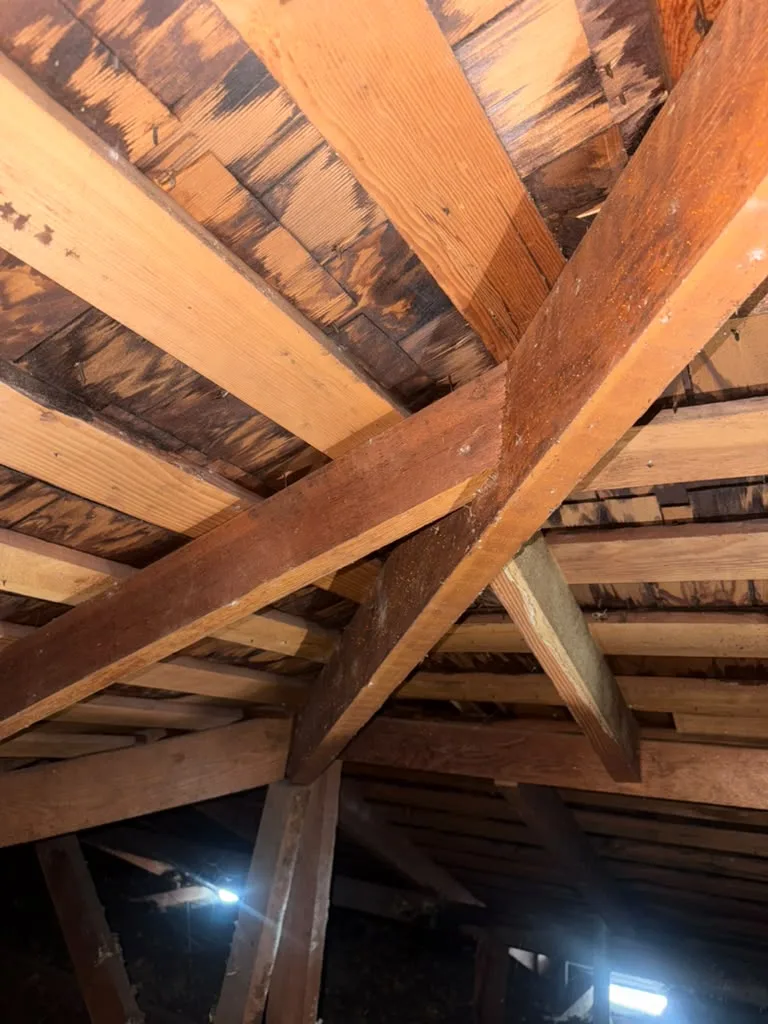
Can a new layer go over the old one?
Sometimes, but there is a limit. The California Residential Code does not allow a new shingle roof over two or more existing layers. The roof above already had three layers, so it had to be a full tear-off down to the deck. Its deck was also spaced boards, the way many older Valley and Los Angeles houses were built, which needs solid sheathing before a modern shingle roof goes on. Both facts change the job, and neither shows from the street. That is why the attic look matters.
Repair or replace?
- Repair makes sense when the problems are local: one flashing detail, a few cracked or missing shingles or tiles, a clogged gutter, and the rest of the roof is sound.
- Replace it when the wear is everywhere, the layers are at the limit, or the deck under it is failing. Spot repairs on a roof like that buy months.
When we replace a roof it goes down to the wood deck, gets new underlayment and flashing at every pipe, vent, wall and skylight, then the new roof and ridge caps. Here is one we did in Tarzana.

Book a free roof inspection
Use the short form at the top of this page or call (818) 934-0075. More: Roofing.