Book a free site visit.
Got it.
Rather talk now? Call (818) 934-0075.
Before the first tool comes out, the protection plan for your house and yard should be agreed and in writing. A few parts of that plan come from law. In a home built before 1978, federal lead rules set how dust is contained and cleaned. In the City of Los Angeles, building plans carry storm water notes that keep dirt and concrete out of the street. California’s Civil Code sets what neighbors are told before deep digging near the property line. The rest is agreed between you and the builder: where the materials go, which paths the crew uses, and what stays off limits.

Why damage and dust happen on home jobs
Damage on a home job can come from the ordinary work, done in a tight space next to a house people still live in. A saw cuts through old paint. A concrete truck backs over a sprinkler line. A wheelbarrow takes the shortest way across the lawn. Dust from a wall opened in the kitchen settles in the bedroom down the hall.
None of that needs bad intent. It happens when nobody decided in advance where the work area ends, how it is sealed off, and what the cleanup looks like before the area goes back to the family. So the protection plan matters as much as the build plan, and it belongs in the conversation before you sign.
Lead paint in homes built before 1978
Start with the year your house was built. The EPA’s Renovation, Repair and Painting rule covers paid work that disturbs paint in those homes. That includes remodeling, electrical, plumbing, carpentry, painting prep and window replacement.
What the rule requires, from EPA’s March 2026 compliance guide:
- A certified firm and trained workers. Every firm doing this work must be certified, even a one-person shop, and the people doing it must be trained in lead-safe work practices.
- The pamphlet first. Before the work starts, the firm gives the owner and the people living there EPA’s lead pamphlet and keeps a confirmation that you received it. If it is mailed, it goes out at least 7 days before the work.
- Inside the house. Objects come out of the work area or get covered with sealed plastic. Ducts in the area are closed and covered. Windows and doors are closed, and doors are covered with plastic. Taped-down plastic covers the floor at least 6 feet past the work.
- Outside the house. Doors and windows within 20 feet are closed. Plastic covers the ground at least 10 feet past the work. Where a property line is closer than that, the firm puts up vertical containment so dust stays off the neighbor’s side.
- Methods that are banned. Open-flame burning of painted surfaces, power sanding or grinding without a shroud and HEPA vacuum attachment, and heat guns above 1100 degrees Fahrenheit.
- Cleanup and a check. Paint chips and debris are sealed in heavy-duty bags. Surfaces are cleaned with a HEPA vacuum and damp cloths. A certified renovator then runs a cleaning verification before the area is used again.
Small jobs are excluded: 6 square feet of painted surface or less per room inside, or 20 square feet or less outside. Window replacement and demolition never count as small. Homes built in 1978 or later fall outside the rule. EPA’s guide also says state and local rules can go further than the federal ones.
To check a firm, use EPA’s certified firm search on its consumer page. Certified firms show the EPA Lead-Safe logo.
Mud, concrete and the street
An ADU, a garage conversion or an addition moves a lot of soil. In the City of Los Angeles, the Department of Building and Safety requires a set of storm water notes on the approved plans for construction that disturbs soil, demolition included. Interior remodeling with no outside exposure is left out. The 2026 version of the form sets these minimums:
- Dirt and sediment stay on the site, carried off by neither water nor wind.
- Piles of soil and materials are covered or protected.
- Fuel, oil and solvents are stored so they stay out of the soil. Spills are cleaned up right away and never washed into a drain.
- Water from washing tools, equipment and vehicles stays on the site.
- Leftover concrete is never washed into the street or a storm drain. It stays on site until it is hauled off or recycled.
- Trash and construction waste go in covered bins.
- The entrance is stabilized so trucks do not track dirt into the street. Dirt that does get out is swept up at once and never hosed down.
These notes protect the street and the storm drain, and they also protect your driveway, your lawn and the neighbor’s curb. Concrete day and demolition day are when they matter most.
Digging near the property line
Footings for an ADU or an addition can run close to the side or rear fence. California Civil Code section 832 sets the duties when one owner digs next to another owner’s land:
- The owner planning the excavation gives reasonable notice to the neighbors, stating how deep the digging will go and when it will start.
- The digging is done with ordinary care, with reasonable precautions to support the neighbor’s land.
- If the excavation will go deeper than the neighbor’s walls or foundation and close enough to put them at risk, the neighbor gets at least 30 days to protect the building, with reasonable access to do it.
- Excavations deeper than 9 feet below curb level carry further duties.
A short note to the neighbors before the footings are dug heads off questions later in the job. Ask who sends it, you or the builder, and what it will say.
What to settle before the work starts
These points come from practice. No statute lists them. Each one is easier to agree before the job than to argue about during it.
- Where the work area starts and stops, inside and outside.
- Where materials, the dumpster and the portable toilet will sit.
- Which gate, side yard and path the crew uses, and which parts of the yard stay off limits.
- How floors, stairs and landscaping on the path get covered.
- Where the sprinkler lines, the gas line and the sewer cleanout are, marked before any digging.
- Which rooms stay usable, and how the HVAC is handled while there is dust.
- What gets cleaned at the end of each day, and what the final cleanup includes.
- Who you call if something gets damaged, and how it gets written down.
Take your own dated photos of the house, the driveway, the yard and the fence lines before the job starts. If a question comes up later, you and the builder are looking at the same picture.
Checklist before you sign
- Was the house built before 1978? If so, is the firm EPA- or state-certified for lead work?
- Did you get EPA’s lead pamphlet before the work started, and sign for it?
- Does the plan show where plastic goes inside, and how far it reaches outside?
- Is the HVAC in the work area closed off during dusty work?
- Are the storm water notes on the approved plans, if the job disturbs soil?
- Where will concrete trucks wash out, and where will soil piles sit, covered?
- Will the neighbors get notice before footings are dug near the property line?
- Are the off-limits areas, crew path and material spots written down?
- Are underground lines and sprinkler heads marked before digging?
- What does the daily cleanup include, and what does the final cleanup include?
- Who do you call about damage, and how is it recorded?
- Do you have your own dated photos from before the work?
A real job, stage by stage
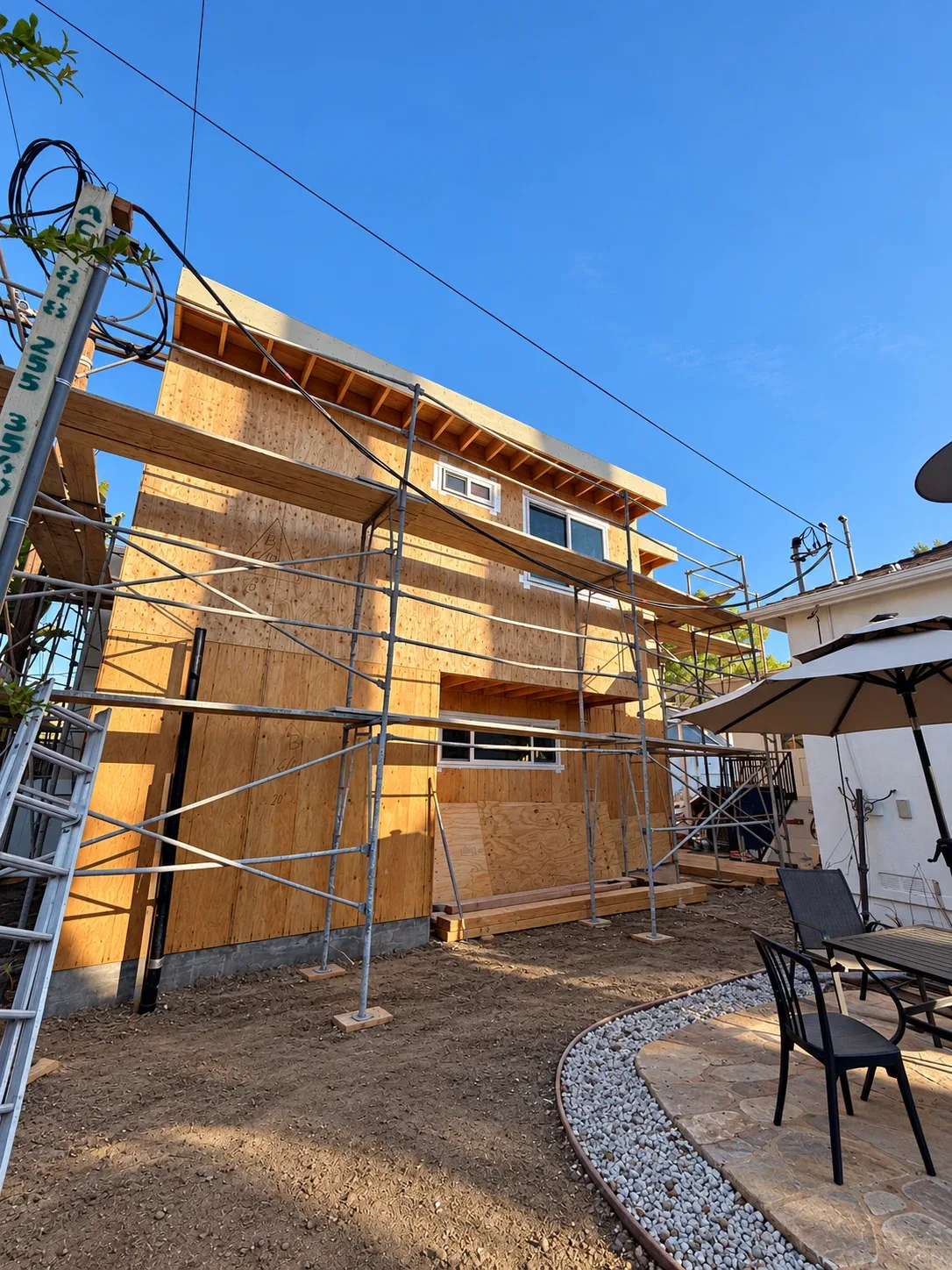
The two-story ADU we built in Encino went from slab to stucco, and each stage lines up with a rule above. First the slab was poured. Pour day is when the storm water notes matter most: covered soil piles, a stabilized path for the trucks and concrete waste kept on the lot. Framing and plywood sheathing came next, with the windows set. Then the stucco scratch coat, a wet stage where windows and the ground along the walls need covering. Each stage brings a different risk to the house and yard, so the protection gets checked again before each one starts.

For what the city inspector checks at each stage, see our article on checking the work behind the walls. For putting the agreed details into the contract, see what the scope of work should say.
How it works with MAMOS
- One team handles the design, the permits and the build. We prepare the drawings, file the city submittal, answer the plan-check corrections and meet the inspectors.
- We start with a free site visit. After we have seen your property, you get a written scope and quote for your address.
- During the job you get a written update with photos every week.
- On an active MAMOS project, urgent water or electrical problems go to (818) 934-0075, and the on-call line picks up.
- Warranty is set project by project.
- We call back within 15 minutes: 8am to 5pm Monday to Thursday, 8am to 2pm Friday.
Sources (accessed 2026-10-30)
- EPA, Renovation, Repair and Painting Program (updated June 17, 2026): www.epa.gov
- EPA, Lead Renovation, Repair and Painting Program Rules (updated December 15, 2025): www.epa.gov
- EPA, Renovation, Repair and Painting Program: Consumers (updated May 27, 2026): www.epa.gov
- EPA, Small Entity Compliance Guide to Renovate Right (EPA-740-K-26-003, March 2026): www.epa.gov
- LADBS, Storm Water Pollution Control, Form GRN 1 (revised January 1, 2026): dbs.lacity.gov
- California Civil Code section 832: leginfo.legislature.ca.gov
This article explains what the published rules say. It is not legal advice. Rules change, and the city and the agencies decide for a specific lot; ask EPA, LADBS or an attorney about your own job.
Questions homeowners ask
Does my contractor have to follow lead-safe rules?
If your home was built before 1978 and the paid work disturbs painted surfaces, the EPA rule applies. The firm must be certified, its workers trained, and you get EPA’s lead pamphlet before the work starts. Small jobs of 6 square feet or less per room inside, or 20 square feet or less outside, are excluded. (EPA, Small Entity Compliance Guide, March 2026.)
Can concrete or wash water go into the street during construction?
In the City of Los Angeles, the storm water notes on approved plans say leftover concrete may never be washed into the street or a drain, and wash water from tools and vehicles stays on the site. Dirt tracked into the street is swept up, never hosed down. (LADBS Form GRN 1.)
Do my neighbors need notice before footings are dug?
California Civil Code section 832 says an owner planning an excavation gives reasonable notice to the adjoining owners, with the depth and the start date. If the digging goes deeper than a neighbor’s foundation and close enough to risk it, the neighbor gets at least 30 days to protect the building. Ask an attorney about a specific lot. (Civil Code 832.)
Book the free site visit through the short form at the top of this page (back to the form). More on how we build: ADUs and garage conversions.
Free site visit: (818) 934-0075