Book a free site visit. Leave your number and we will call you back.
Got it.
Rather talk now? Call (818) 934-0075.
The inspection record tells you. On a permitted project, each stage has to be inspected and approved before it is covered up, every inspection is recorded on the job’s Building Card, and in the City of Los Angeles you can look up the inspection history online. Knowing what those records should show, and asking to see them at each stage, is the most practical check a homeowner has. (Sources: Los Angeles Department of Building and Safety and LA County Public Works pages, linked below. The inspector decides what is required for a specific project.)
Why workmanship problems hide
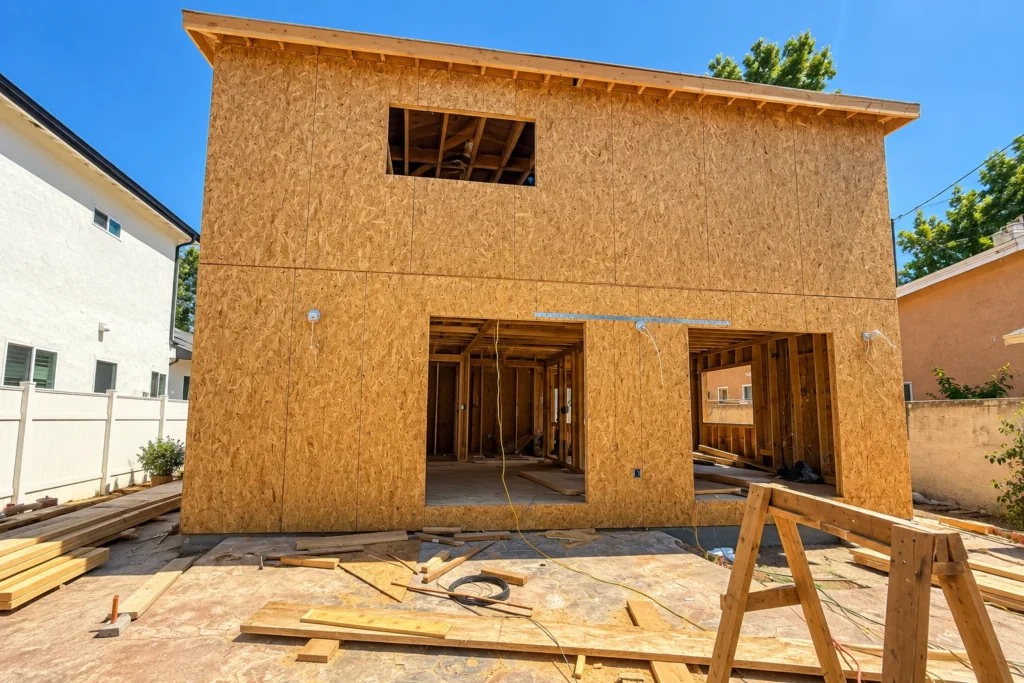
Most of the work that decides whether a room stays dry and safe ends up out of sight: the slab and the vapor barrier under the floor, the framing and its nailing, the wiring and pipes in the walls, the insulation, the flashing around windows, the lath under the stucco. Once drywall and stucco go on, nobody can see it without opening a wall.
That is why the city inspects in a sequence. The Los Angeles building department says you must call for an inspection before covering or concealing any work, that work is approved in succession, and that work may not continue past each point until the inspector approves it. Its words are plain: the work “is not approved until it has been inspected and accepted” (LADBS, Inspection).
First, find out who inspects your project
If your property is inside the City of Los Angeles, the Department of Building and Safety (LADBS) issues the permit and inspects. If it is not, another department serves your area. LADBS points homeowners to two tools to find out: the City Planning ZIMAS map, and the LA County Online Service Locator, which shows which department serves an address. If your property does not appear in ZIMAS, it may be outside the City of Los Angeles (LADBS, About the Construction Process). The names of the inspections below differ between departments, but the idea is the same everywhere.
Inspection sequence for a garage-to-ADU conversion
LA County Public Works publishes an inspection checklist for one common project, converting a garage into an ADU. It lists five inspections, and the project is complete only when all five are passed (LA County, ADU Inspection Checklist, Rev 1/31/2023). In plain words:
- Underground utilities. Before anything is buried: setbacks, under-slab plumbing, underground electrical, water service, gas piping, backflow and sewer connection.
- Foundation or slab. Before concrete covers it: slab and steel, the grounding electrode, anchor bolts and hold-downs, and early checks on shear walls.
- Final frame and rough trades. With the walls still open: vapor barrier, roof sheathing, rough wiring and panels, window flashing, smoke detector locations, rough mechanical and plumbing, gas test, exhaust vents and ducts, and final framing and anchorage. The checklist says insulation has to be on site for the inspector to verify its rating.
- Drywall, shower pan and exterior lath. Insulation is verified before drywall goes up; then interior drywall, exterior lath, fire-rated walls and ceilings where required, the shower pan and the gas test.
- Final. Final electrical, mechanical and plumbing, lot drainage, posted address, other agency approvals and reports, then the building final and the Certificate of Occupancy.
Your project may have more or fewer inspections. LADBS says the number and type vary with the project (LADBS, Homeowner Step-By-Step). The useful part for a homeowner is the pattern: each inspection happens just before something gets covered.
What you can check yourself, without being a builder
Checking nailing and hold-downs is the inspector’s job. Your part is to make sure each sign-off is on record.
- The permit and the approved plans are on site. LADBS says a copy of the permit and the approved plans (if plan review was required) must be available at each inspection, along with the Building Card (LADBS, Inspection).
- The Building Card is filled in as the job goes. Each inspection is recorded on the Building Card, called the B-8 in the City of Los Angeles (LADBS, Homeowner Step-By-Step). Ask to see it after each stage.
- The inspection history online matches. The City of Los Angeles Permit and Inspection Report shows each permit and its inspection activity (City of LA, Permit and Inspection Report help). If the card and the online record disagree, ask why.
- Nothing gets covered early. Before drywall, stucco lath or a slab pour, ask one question: “Has this stage been inspected and approved?” If the answer is no, the covering waits.
- A failed inspection means corrections before the next stage. LADBS says work that does not pass needs corrections before the project continues (LADBS, Homeowner Step-By-Step). Ask what the inspector asked for and how it was fixed.
- Dated photos of open walls. Before the walls close, take photos of every room. They cost nothing and help any future repair or remodel.
Why the final paperwork matters long after the crew leaves
At the end there is a final inspection and, if applicable, a Certificate of Occupancy, which confirms the building is safe to occupy for its intended use. LADBS tells homeowners to keep the Certificate and the Building Card (LADBS, Homeowner Step-By-Step), and says permits and inspections give you documentation if you sell or refinance (LADBS, About the Construction Process). The city’s own permit report adds that the legal use of a building can only be determined by a valid Certificate of Occupancy issued after the required inspections (City of LA, Permit and Inspection Report help). For an ADU you plan to rent or one day sell with the house, that piece of paper matters.
If you are deciding when the last payment is due, our guide on paying for an ADU without paying ahead of the work covers how payments line up with finished stages.
Checklist to use with any contractor
- Do you know which department issues your permit and inspects your project?
- Is the permit on site, with the approved plans?
- Have you seen the Building Card, and does it show each inspection signed off?
- Does the online inspection history match the card?
- Before any concrete pour, drywall or stucco lath, was the stage under it inspected and approved?
- If an inspection failed, do you know what was corrected?
- Did you take dated photos of every room before the walls closed?
- Did the project get a final inspection, and a Certificate of Occupancy where one applies?
- Do you have the Certificate and the Building Card in your files?
How it works with MAMOS
- MAMOS Construction & Design is a licensed California contractor, license number 1092889. You can verify it yourself at cslb.ca.gov.
- One team handles the design, the permits and the build.
- We prepare the drawings, file the city submittal, answer the plan-check corrections and meet the inspectors.
- We start with a free site visit. After we have seen your property, you get a written scope and quote for your address.
- We call back within 15 minutes: 8am to 5pm Monday to Thursday, 8am to 2pm Friday. Phone (818) 934-0075.
Sources (accessed 2026-10-04)
- Los Angeles Department of Building and Safety, “Inspection”: https://dbs.lacity.gov/services/inspection
- Los Angeles Department of Building and Safety, “Homeowner Step-By-Step”: https://dbs.lacity.gov/services/homeowner-step-by-step
- Los Angeles Department of Building and Safety, “About the Construction Process”: https://dbs.lacity.gov/services/getting-started/about-the-construction-process
- City of Los Angeles, Permit and Inspection Report help: https://www.permitla.org/ipars/appl_help.cfm
- LA County Public Works, “Conversion of Garage to Accessory Dwelling Unit, Inspection Checklist” (Rev 1/31/2023): https://dpw.lacounty.gov/bsd/lib/fp/Building/Residential/Accessory%20Dwelling%20Units/ADU%20Inspection%20Checklist.pdf
This article explains what published agency pages say. It is not legal or engineering advice. Requirements change, and the building department and its inspector decide what a specific project needs.
Questions homeowners ask
What happens if an inspection fails?
The work does not move on. The Los Angeles building department says that if work does not pass inspection, corrections have to be made before the project can continue, and work may not go past each inspection point without the inspector’s approval. Ask what the inspector asked for and how it was corrected. (LADBS, Homeowner Step-By-Step and Inspection.)
Where can I see which inspections my project has passed?
On the Building Card kept with the permit on site, called the B-8 in the City of Los Angeles, where each inspection is recorded. In the City of Los Angeles you can also look up the permit and its inspection activity online in the Permit and Inspection Report. Other cities and LA County keep their own records. (LADBS, Homeowner Step-By-Step; City of LA, Permit and Inspection Report help.)
Why does the Certificate of Occupancy matter?
It is issued at the end, where applicable, after the final inspection, and confirms the building is safe to occupy for its intended purpose. The city’s permit report notes that the legal use of a building can only be determined by a valid Certificate of Occupancy, and the building department tells homeowners to keep it together with the Building Card. (LADBS, Homeowner Step-By-Step; City of LA, Permit and Inspection Report help.)
Free site visit for an ADU, a garage conversion or a remodel
Book the free site visit, and you will get a written scope and quote for your address. Use the short form at the top of this page (back to the form) or call (818) 934-0075. More on how we build: ADUs and garage conversions.