Water coming in? Leave your number and we call you back.
Got it.
Water coming in right now? Call (818) 934-0075.
After a storm you may find a wet patch low on a wall, bubbling paint under a window or a dark line along the baseboard. Most people look up at the roof first, but on a stucco house water very often comes in through the walls and the openings in them. Here is where it gets in, how to tell, and what to fix before the next storm.
Is it the roof or the wall?
A few quick clues help narrow it down:
- Stain on the ceiling: usually the roof, or water running down inside the wall from the roof edge. Our roof leak guide covers that case.
- Stain under a window corner, spreading down: usually the window, or the stucco and flashing around it.
- Damp along the bottom of a wall: often water at the base of the stucco, or soil and planters piled against it.
- Only when rain comes from one direction: wind-driven rain on one side of the house, which points to that wall.
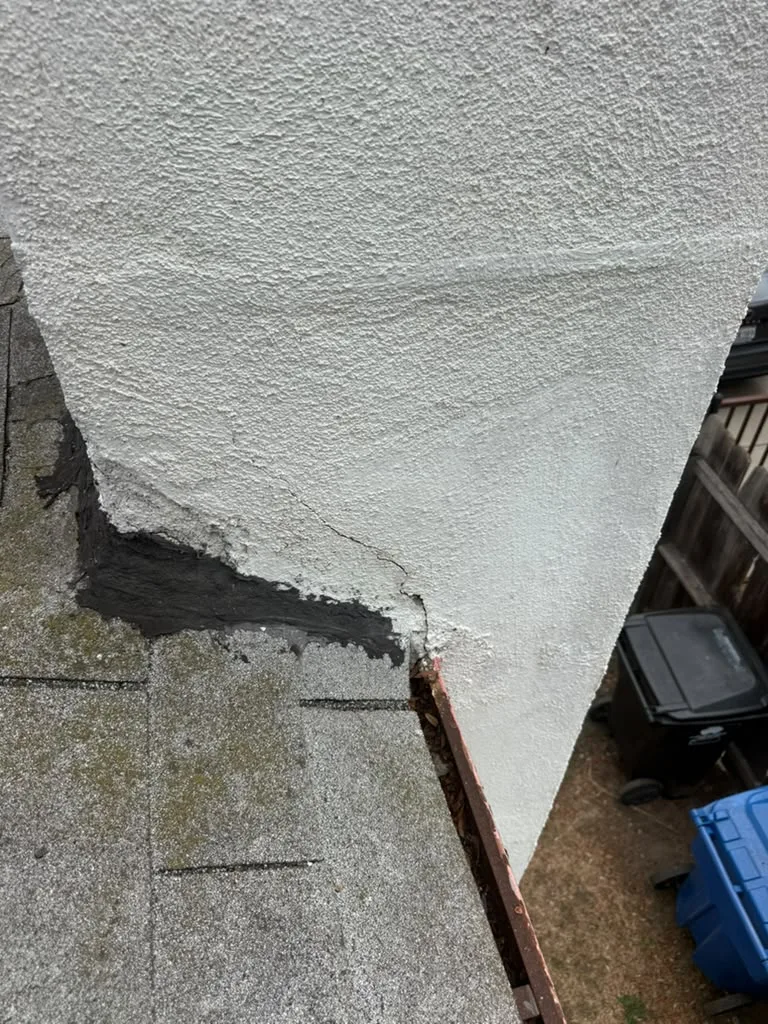
Where water gets into a stucco wall
Stucco is not waterproof on its own. It sheds most of the rain, and a paper or membrane layer behind it handles the rest, draining down and out at the bottom. Leaks happen where that system is broken or blocked:
- Around windows and doors. The corners are the weak point. Cracks that run diagonally from a window corner, failed sealant, or flashing that was never lapped correctly let water behind the stucco.
- Cracks that are wide, growing or stepped. Fine surface cracks are common and usually cosmetic. Wider cracks, ones that keep growing, or ones you can catch a fingernail in are worth a look. We explain the difference in which stucco cracks matter.
- The bottom edge of the wall. The metal strip at the base of the stucco, the weep screed, is where water behind the wall is meant to drain out. When soil, mulch, a planter or concrete covers it, the water has nowhere to go but in.
- Where the wall meets the roof. Patio covers, additions and second-floor walls that rise above a lower roof need flashing at that joint. It is a common source of leaks that look like they come from the wall.
- Penetrations. Hose bibs, light fixtures, vents, cable and gas lines. Every hole through the stucco needs to be sealed, and older sealant dries out in Valley heat.
- Gutters and downspouts. A clogged gutter can pour over the edge and sheet down one wall all storm, and a downspout that empties against the house soaks the base of the wall.
A 15-minute walk around the house before the rain
- Look at every window corner, outside and inside, for cracks, gaps in sealant or old stains.
- Walk the base of every wall. The bottom few inches of stucco and the metal edge should be visible, with soil sloping away from the house.
- Note any crack you can fit a fingernail into, and take a photo with something for scale so you can see later whether it grew.
- Check that every downspout drains away from the wall, not into a planter against it.
- Look at the joints where a patio cover or a lower roof meets a wall.
- Inside, check closets and the backs of cabinets on outside walls. Water often shows there first.
What not to do
- Do not seal the bottom edge of the stucco. Caulking or painting shut the weep screed traps water inside the wall.
- Do not smear caulk over a crack and paint it. If water is already behind the stucco, covering the crack hides the problem without stopping it.
- Do not pressure wash old stucco before the rain. It can drive water into cracks and loosen weak patches.
If water comes in during a storm
Keep away from water near outlets and switch off that circuit if you can do it from a dry spot. Catch and soak up the water, move furniture and rugs off the wet wall, and take dated photos inside and out. Once the rain stops, open closets and cabinets on that wall so they can dry, and call us. Walls that stay damp inside are where mold starts, so it is worth finding the cause rather than waiting for the stain to fade.
Why one company for the roof and the walls helps
Many leaks sit right where two trades meet: the roof edge and the wall, the window and the stucco, the gutter and the fascia. When one contractor looks at the whole exterior, the joints between trades get checked too. MAMOS does roofing, stucco repair, gutters and exterior paint, so one visit covers all of it.
Getting ready for the storms? Our winter storm roof guide covers the roof side. Leave your name and number at the top of this page, or call (818) 934-0075. We call back within 15 minutes: 8am to 5pm Monday to Thursday, 8am to 2pm Friday.